
Case study
BentaBuddy
Filipino small businesses that sell through Facebook Pages take orders inside chat threads. BentaBuddy reads those conversations with a language model running on the owner's own computer, drafts a structured order or booking, and waits for the owner to approve it before anything enters the workflow.
- Category
- Applied AI / Full-Stack Development
- Team
- Hackathon project
- Year
- 2026
No real customer adoption or business savings are claimed. Demo records are fictional.
Part 1
ContextThe problem and where I fit in.
01Problem
For sellers who take orders through Facebook Pages, the conversation is the order form. Customers write in Taglish, change quantities, move pickup times, and add details across several messages.
The owner has to reconstruct the latest version of each request while also preparing goods or serving customers—which makes copying mistakes and missed corrections easy.
02My role
- Built the application across the React frontend, the FastAPI backend, and the local-inference integration.
- Designed the review-first workflow: the model proposes, the application validates, and the owner approves.
Team: Hackathon project
Part 2
BuildWhat was made, and why it was made that way.
03Solution
New Page messages (or pasted conversations) are read by a local model against the active business catalog. The model returns schema-constrained JSON: items, quantities, schedule, fulfillment details, clarification questions, and the source excerpts it relied on.
Application code then validates every field and computes everything that has to be exact—prices, dozen conversions, nights, booking conflicts, and analytics—before the owner sees a draft to edit and approve.
04Features
Conversation interpretation
ImplementedReads Taglish messages and applies later corrections, e.g. “2 dozen bukas, 8am” then “gawin na lang 3 dozen, 9am” becomes 36 pieces at 9am.
Structured order drafts
ImplementedDrafts include supporting message excerpts and clarification questions instead of silent guesses.
Business-specific catalogs
ImplementedBakery, gadget shop, staycation, and general product or service modes, each with its own catalog and fulfillment board.
Owner approval workflow
ImplementedNothing affects orders, bookings, or schedules until the owner reviews and approves the draft.
Order and booking management
ImplementedRevisions, filters, CSV export, activity history, manual payment recording, and transactional booking-overlap checks.
Local AI inference
ImplementedQwen3-4B-Instruct runs through llama.cpp on the owner's machine. No cloud AI API is used.
Human-in-the-loop validation
ImplementedInvalid or incomplete model output fails visibly rather than being patched over.
05Architecture
Interface
Responsive web app, also opened from a phone over the local network
Responsive web app, also opened from a phone over the local network
- React 19
- TypeScript
- Vite
API & rules
Validation, workflows, pricing, conflicts, analytics
Validation, workflows, pricing, conflicts, analytics
- Python
- FastAPI
- Pydantic
Local inference
Schema-constrained JSON extraction on the owner's computer
Schema-constrained JSON extraction on the owner's computer
- Qwen3-4B-Instruct (Q4_K_M)
- llama.cpp
- Ollama (optional)
Storage
Catalogs, conversations, customers, orders, payments, events
Catalogs, conversations, customers, orders, payments, events
- SQLite
Messaging
Webhook-only relay for incoming Page messages
Webhook-only relay for incoming Page messages
- Messenger webhooks
- cloudflared
The web app, database, and model run on the owner's computer. Only the webhook route is exposed through the tunnel.
06Engineering decisions
The model interprets; code decides
The language model only reads and proposes. Catalog IDs, units, quantities, dates, and quoted source excerpts are validated in code, and all arithmetic happens in code—so a confident-sounding model answer can never set a price.
Local-first by design
Running inference locally avoids sending customer conversations to another cloud AI provider and keeps extraction, review, and order management working offline after setup.
Fail visibly, never silently
Repeated item lines ask for clarification instead of inflating totals, and stale proposals are rejected. There is no cloud fallback that could quietly change behaviour.
A pretrained model, used carefully
The model was not trained or fine-tuned for this project. Reliability comes from task instructions, schema-constrained output, bounded context, and validation.
Part 3
ResultsWhat came of it, honestly.
07Outcomes & limits
Outcomes
- Working prototype covering conversation intake, local extraction, owner review, fulfillment boards, customers, and analytics across four business types.
- Per the project README (Oct 10, 2026): 87 automated tests and the production build pass, plus separate real local-model checks on fictional data.
Limitations
- Single-owner prototype: no sign-in or multi-shop isolation.
- New Messenger messages need internet; public customer access depends on Meta permissions and approval.
- No payment verification, courier integration, or inventory forecasting. Customer payment claims are not treated as verified.
- The bundled setup targets Apple silicon; other platforms need their own local runtime.
Related projects
- Screenshot
AI Integration / Sustainability / PWA
FreshlyFRESHVII
Team project · Team lead · 2026
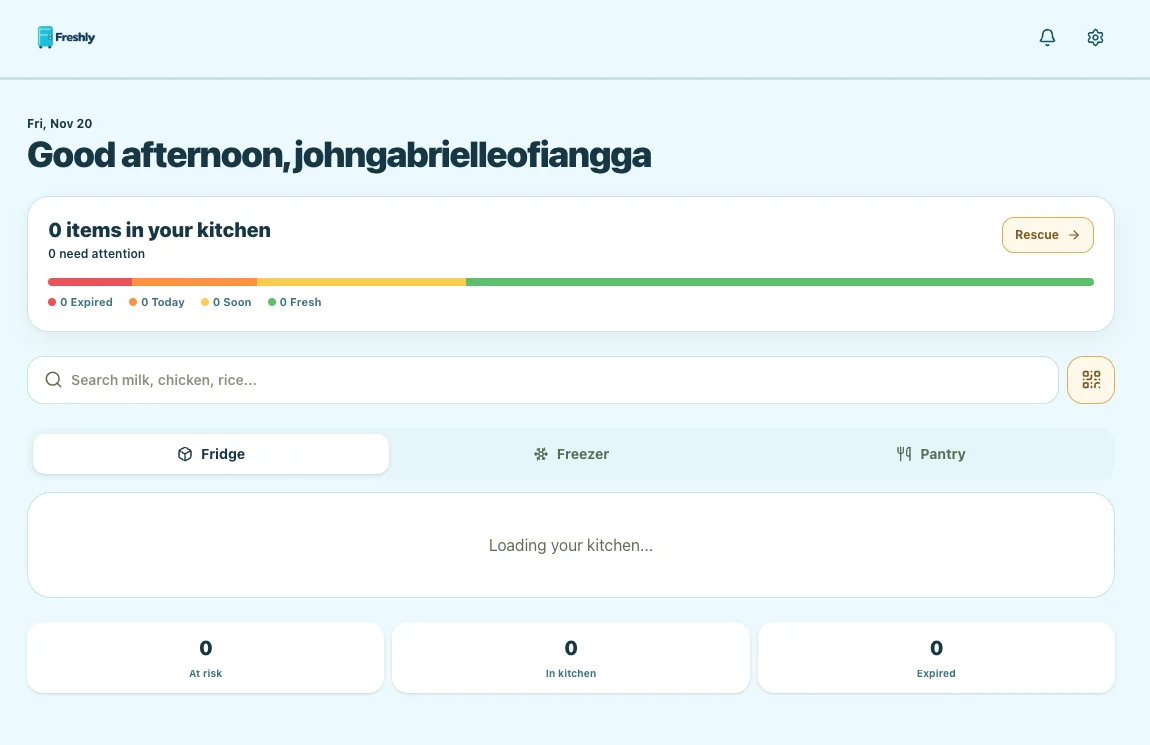
A mobile-first food inventory PWA that helps households waste less with freshness estimates, AI food scanning, and recipe suggestions.
- React
- TypeScript
- Vite
- +5 more
- From pitch deck
Challenge #2 · Know your bill
“Why is my bill like this?”
Meet Eelio.

UI/UX / Product Design / EnergyTech
Eelio
Team LarpItOut · University of Caloocan City · 2026
A mobile-first concept that explains why a household's electricity bill changed—to the peso—and helps it use less next month.
- UI/UX design
- Product planning
- Mobile-first PWA
- +1 more
Case study