Case study
SmartVault
SmartVault connects a physical vault to a mobile app and a backend service that handles secure access workflows, vault state, and real-time coordination between mobile, web, and hardware clients.
- Category
- IoT / Backend Engineering / Mobile
- Team
- Team project
SmartVault is a prototype and is not presented as a certified security product.
Part 1
ContextThe problem and where I fit in.
01Problem
A connected vault has to coordinate a phone, a backend, and hardware in real time—while treating every unlock attempt as a security event.
02My role
- Worked on the backend architecture and the integration between the mobile app, the API, and the vault hardware.
Team: Team project
Part 2
BuildWhat was made, and why it was made that way.
03Solution
A FastAPI service, refactored around Clean Architecture, owns access control and vault state. The mobile app talks to it over REST and WebSockets, so unlocks and state changes reach every connected client in real time.
04Features
PIN-based unlocking
ImplementedHashed PIN validation with lockout after repeated failures.
Biometric authentication
ImplementedFace recognition integration alongside the PIN flow.
Real-time communication
ImplementedWebSocket channels keep the app, web, and hardware in sync.
Mobile app
ImplementedReact Native app for unlocking and monitoring the vault.
Observability
ImplementedMetrics, structured logs with sensitive-field redaction, and health checks.
05Architecture
API layer
HTTP endpoints, WebSocket handlers, validation, dependency injection
HTTP endpoints, WebSocket handlers, validation, dependency injection
- FastAPI
Application layer
Use cases, services, and ports
Use cases, services, and ports
- Python
Domain layer
Users, vaults, access logs, PIN and status value objects
Users, vaults, access logs, PIN and status value objects
- Pure Python
Infrastructure
Repositories, cache and rate limiting, biometrics, notifications
Repositories, cache and rate limiting, biometrics, notifications
- PostgreSQL
- SQLAlchemy
- Alembic
- Redis
Runtime
Containerised services with metrics and error tracking
Containerised services with metrics and error tracking
- Docker Compose
- Prometheus
- Grafana
- Sentry
Dependency rule: inner layers know nothing about outer layers. The domain has no infrastructure dependencies.
06Engineering decisions
Clean Architecture refactor
Separating domain rules from FastAPI, the database, and Redis made the security-critical logic testable in isolation with in-memory fakes.
Security events are first-class
PIN lockouts, authentication failures, and unlock operations are tracked explicitly, and logs redact PINs, passwords, and tokens.
Real-time over polling
WebSockets push vault state changes to clients instead of having each device poll the API.
Part 3
ResultsWhat came of it, honestly.
07Outcomes & limits
Outcomes
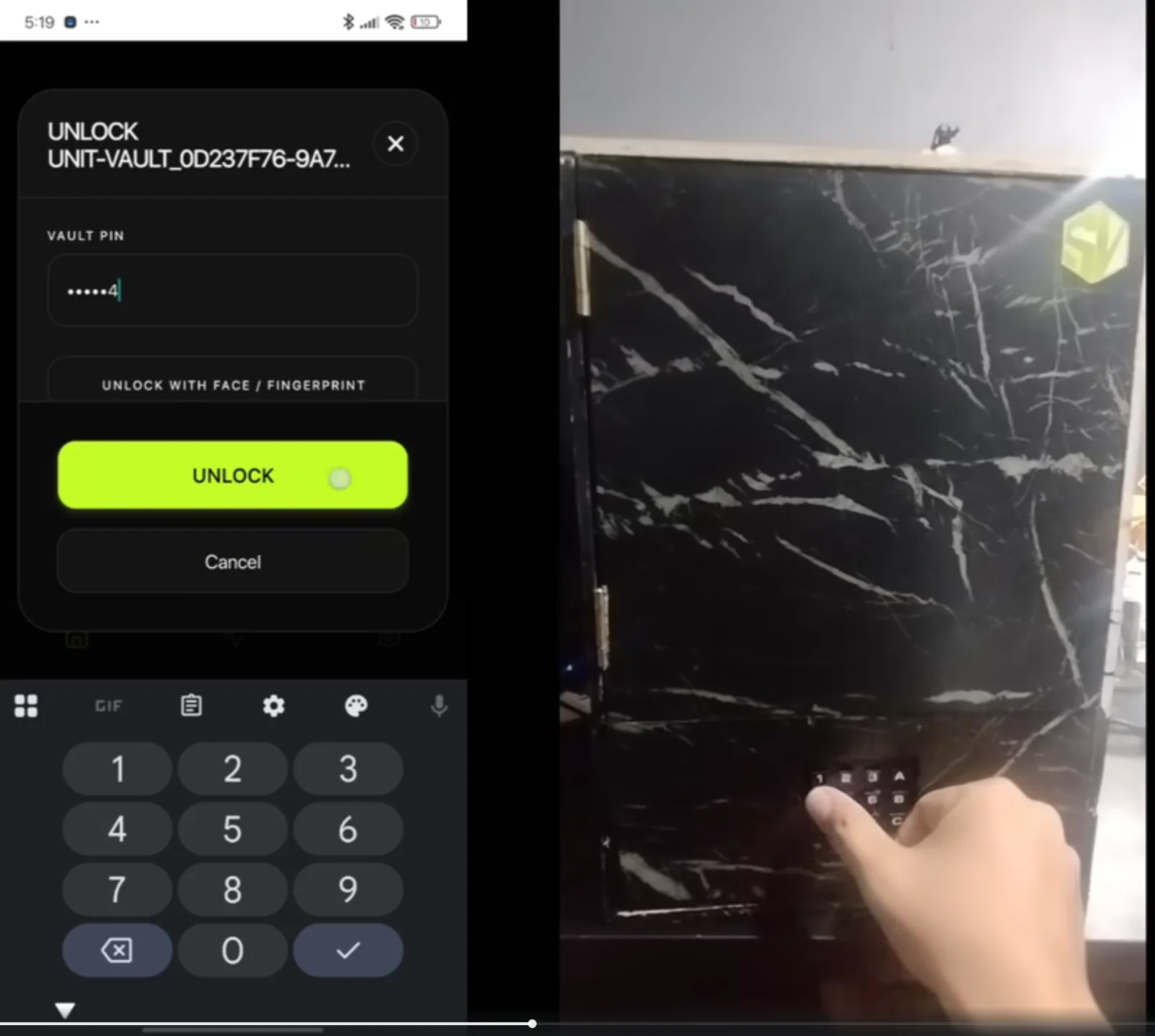
- A working prototype: the mobile app unlocking the physical vault, backed by the API.
Limitations
- A student project and prototype—not a certified or audited security product.
08Gallery
- Demo capture
App unlock flow beside the physical prototype
Related projects
- Illustration
Android / Full-Stack Development
FreshGuide
Team project · 2026
A campus navigation app for the University of Caloocan City with room discovery, directions, class schedules, and offline data.
- Java
- Android
- MVVM
- +4 more
- Illustration
Applied AI / Full-Stack Development
BentaBuddy
Hackathon project · 2026
A local-first AI business assistant that turns customer conversations into structured, owner-reviewed orders and bookings.
- React
- TypeScript
- Vite
- +5 more